
Most Valuable Toys of All Time: What's Actually Worth Money
- The million-dollar club
- Star Wars: still the king of valuable toys
- What else sells for serious money besides action figures?
- What actually makes a toy valuable
- The uncomfortable truth about "valuable" toys
- Where the market is heading
- Key Takeaways
- FAQs
- What is the most expensive toy ever sold at auction?
- Are my childhood toys actually worth money?
- Does grading increase a toy's value?
- Which toy categories are increasing in value the fastest?
- Should I collect toys as an investment?
- Related Posts
A 3.75-inch Boba Fett prototype sold for $1.34 million at Goldin in August 2024. Not a car, not a painting, not a house. A tiny plastic bounty hunter that Kenner made 30 of in 1979 and never actually shipped to stores. That sale broke the all-time auction record for any toy, and it wasn't even close.
I've been tracking these sales for years, and the numbers keep climbing. The toy collectibles market hit $19.2 billion in 2024 and is projected to reach $45.2 billion by 2032. Adults now account for roughly 34% of all toy sales, up from single digits a decade ago. The stuff sitting in your parents' attic (or your own closet) might be worth more than you think, or a lot less than clickbait articles promise.
I put together the actual sale prices, the categories that keep producing big numbers, and an honest take on whether your collection is sitting on a hidden six-figure piece or just a box of fond memories.
The million-dollar club
Only a handful of toys have crossed the million-dollar mark at auction. Every single one is a prototype, one-of-a-kind, or so rare that fewer than five exist.
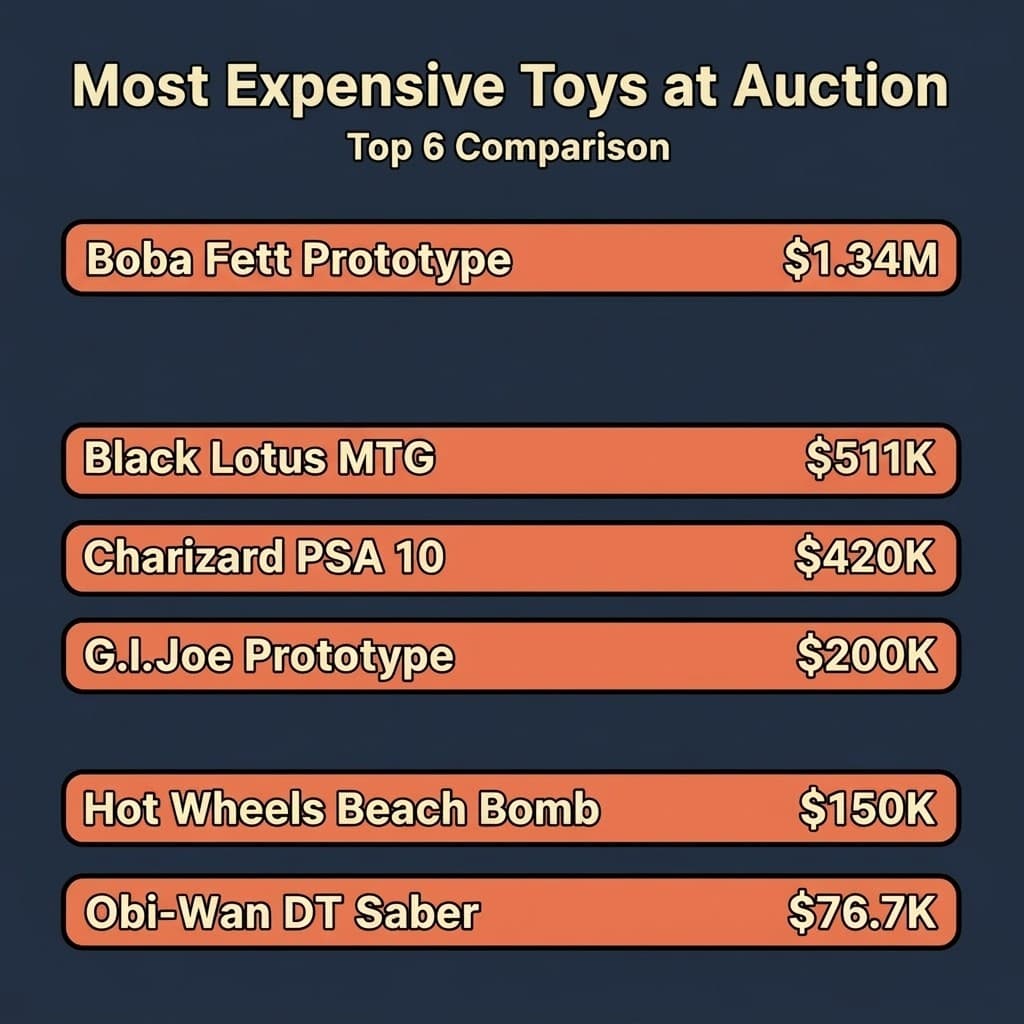
Boba Fett Rocket-Firing Prototype (1979) — $1.34 million
Kenner produced about 30 of these J-Slot prototypes before scrapping the design over choking hazard concerns. Only three are known to survive. The one that sold at Goldin was the highest-graded example and the first to hit a public auction. Two months earlier, a different version sold for $525,000 at Heritage Auctions.
Original G.I. Joe Prototype (1963) — $200,000
The handmade prototype that started the entire action figure category. One buyer paid $200,000 on eBay in 2003. It's the toy equivalent of owning the first draft of a screenplay that launched a billion-dollar franchise.
I'll be honest: these aren't prices you or I will ever see for something in our own collections. But they set the ceiling, and that ceiling keeps rising.
Star Wars: still the king of valuable toys
Star Wars dominates the high-end vintage toy market, and it's not particularly close. Kenner's original 1977-1985 line created the modern action figure aftermarket.
Double-Telescoping Lightsaber figures are the white whale for vintage Star Wars collectors. Early production runs of Luke Skywalker, Darth Vader, and Obi-Wan Kenobi had lightsabers that extended in two stages instead of one. Kenner simplified the design quickly, making the originals scarce. A double-telescoping Obi-Wan sold for $76,700 at Hake's Auctions in 2017.
Vinyl Cape Jawa figures regularly sell for $30,000-$40,000 at auction. Kenner switched from a vinyl cape to a cloth cape early in production, making the vinyl version one of the scarcest figures in the original 12-back lineup.
Every one of these high-value Star Wars figures exists because Kenner changed something early in production. Two weeks of vinyl capes before switching to cloth. A lightsaber mechanism simplified after the first batch. Those short production windows created the scarcity that collectors fight over decades later.
What else sells for serious money besides action figures?
The most valuable toys aren't all action figures. Some of the biggest sales come from categories you might not expect.
Hot Wheels Pink Rear-Loading Beach Bomb (1969) — $150,000+
Only two pink prototypes exist. The rear-loading design was scrapped because the car was too narrow to roll properly on Hot Wheels tracks, so Mattel redesigned it with side-loading surfboards. Regular Beach Bombs sell for a few hundred dollars. The pink rear-loader sells for six figures.
Original 1959 Barbie — $27,450+
The first Barbie ever produced, wearing the black-and-white striped swimsuit. Mint condition with original box and accessories pushes the price well above $25,000. Barbie's seen a 260% growth in collector activity on Whatnot heading into 2026.
Magic: The Gathering Alpha Black Lotus (1993) — $511,100
A sealed copy signed by artist Christopher Rush sold for over half a million in January 2021. Even played copies in decent condition sell for $25,000+. The Black Lotus is arguably the single most recognizable collectible card in any TCG.
Pokemon 1st Edition Shadowless Charizard PSA 10 — $420,000
The card that launched a thousand grading submissions. A PSA Gem Mint 10 sold for $420,000 in 2022. Lower grades still command thousands, with PSA 9s regularly going for $15,000-$25,000.
What actually makes a toy valuable
I see a lot of articles listing random old toys and claiming they're "worth thousands." Most of them aren't. Three things actually move the needle on price:
Rarity beats nostalgia. Something being old and beloved doesn't make it valuable. Millions of people owned Teddy Ruxpin. That's exactly why it's worth $30 on eBay, not $3,000. The toys worth real money were produced in tiny quantities, pulled from production early, or never officially released at all.
Condition is everything. A loose G1 Transformers Astrotrain sells for about $58. A complete one with the box goes for $75-$90. A factory-sealed Astrotrain has sold for around $600. That's a 10x premium for the same toy in better condition. AFA grading amplifies this further, but grading only makes financial sense for toys already worth $200+ loose.
Provenance matters. The $1.34 million Boba Fett wasn't just rare. It was the highest-graded of three known examples and the first to sell at public auction. Having documentation and a clean chain of ownership pushed the price even higher.
The uncomfortable truth about "valuable" toys
Here's what those clickbait articles won't tell you: the toys that sell for six and seven figures are almost always prototypes, production errors, or items that never made it to retail shelves. They're the exception, not the rule.
CNN reported in 2024 that the broader vintage toy market doesn't match the headline-grabbing auction results. Most vintage toys in good condition sell for $20-$200. That's still money, but it's not retirement money.
Where I see the best balance between enjoyment and actual resale value is the $500-$5,000 range. Figures like a carded vintage Star Wars Yoda (AFA 80+), a complete Fortress Maximus Transformer, or a sealed first-generation Pokemon booster box. These are liquid enough to actually sell when you want to, and they've shown steady appreciation over the past decade.
If you're collecting primarily for investment, I'd argue you're doing it wrong. The collectors I know who've made the most money are the ones who bought what they loved, kept it in good shape, and happened to be sitting on something desirable 20 years later. Avoiding common mistakes matters more than chasing the next Boba Fett.
Where the market is heading
The collector base is expanding fast. Circana reported the global toy industry grew 7% in 2025, fueled by pop culture collectibles and kidult spending. Whatnot hit $6 billion in GMV in 2025, doubling year-over-year, with Pokemon cards, LEGO, and Barbie all seeing 245-260% growth on the platform.
Nostalgia cycles are predictable. The toys that millennials grew up with (Pokemon, Digimon, early Transformers Beast Wars, Bionicle) are entering their peak collector demand window right now. Gen Z is just starting to feel nostalgic about the toys from their childhood, which means 2010s-era items could be the next wave.
I'm not saying rush out and buy Beast Wars figures. But if you're paying attention to what a new generation of collectors is starting to care about, you can pick up pieces before the rest of the market catches on.
Frequently Asked Questions
What is the most expensive toy ever sold at auction?
The Boba Fett Rocket-Firing Prototype sold for $1.34 million at Goldin in August 2024. Kenner produced about 30 of these prototypes in 1979 before canceling the design. Only three are known to exist, and this was the first to sell at public auction.
Are my childhood toys actually worth money?
It depends on the specific toy, condition, and rarity. Most mass-produced toys from the 1980s and 1990s sell for $20-$200 even in good condition. The toys worth thousands are typically production errors, early variants, or items pulled from shelves quickly. Check recent sold listings on eBay (not asking prices) for a realistic value.
Does grading increase a toy's value?
Professional grading from AFA or CAS can increase value for sealed, high-condition toys already worth $200+ loose. A factory-sealed vintage Transformer might sell for $600 graded versus $75-$90 ungraded with box. But grading costs $50-$200+ per item, so it doesn't make financial sense for common figures worth under $100.
Which toy categories are increasing in value the fastest?
Pokemon cards, LEGO sets, and Barbie collectibles all saw 245-260% growth on Whatnot in 2025-2026. Vintage Star Wars remains the most consistently valuable category overall. Blind box art toys like Labubu are a newer category seeing explosive growth, with 1,455% sales increases in some markets.
Should I collect toys as an investment?
I wouldn't recommend buying toys purely as investments. The items that appreciate the most are impossible to predict in advance, and the market is illiquid compared to stocks or real estate. Collect what you enjoy, store it properly, and treat any future value as a bonus. The collectors who've done best financially are usually the ones who bought out of passion and held for decades.
Enjoyed this? Get collector insights delivered weekly.
Join the Bamboo Club for weekly collector tips, trends, and exclusive finds.
By subscribing you agree to receive Pando Market marketing emails. We will email you a link to confirm. Unsubscribe anytime. See our Privacy Policy.
Related Posts
Learn how to spot fake collectibles across action figures, Labubu blind boxes, Funko Pops, and trading cards. Protect your collection and your wallet.
Avoid the most common toy collecting mistakes. Learn how to spot fakes, store collectibles properly, set a budget, and stop overpaying on the aftermarket.