
7 Toy Collecting Mistakes that Cost Real Money
- FOMO buying and the 48-hour rule
- Falling for fakes (across every category)
- Bad storage ruins everything (slowly)
- Not setting a budget (especially with blind boxes & cards)
- Chasing completionism
- Not tracking your collection
- Overpaying on the aftermarket
- Key Takeaways
- FAQs
- How do I spot a fake Labubu or Pop Mart blind box?
- What's the best way to store Pokemon cards long-term?
- How much do collectors typically spend per month?
- Should I grade my Pokemon cards or action figures?
- Are blind boxes and trading cards a waste of money?
- Related Posts
I've creased Pokemon cards in a 3-ring binder that pressed into them over months. Left others in boxes outside where water got to the packaging. Bought an X-Men '97 Marvel Legends Cyclops and Wolverine each for $50 after binging the Disney+ series much later after release of season 1, then watched Hasbro reissue the same figures a couple months later for around $30. And yeah, I got caught up in the Labubu blind box hype too.
Doesn't matter what you collect. Same traps, same fixes.
FOMO buying and the 48-hour rule
This gets everyone regardless of what you collect. A Pop Mart drop sells out in minutes. A Marvel Legends exclusive hits hasbro pulse and everyone's posting haul pics. A Pokemon set gets hyped as "the next big investment." You buy before you've thought about whether you actually want it.
Manufacturers design it this way. Limited runs, timed preorder windows, convention exclusives, retailer-exclusive colorways. The blind box model takes it further by adding randomness on top of scarcity. Pop Mart knows exactly what they're doing when a series has a 1-in-144 secret figure.
Most "limited" items aren't as scarce as they feel at launch. Preorder panic settles. Aftermarket prices drop once hype moves on. Those X-Men '97 figures I paid $50/each for? Reissued at $30 a couple months later. I paid a $40 nostalgia tax because the show had me in my feelings. Good thing I didn't do the same thing for Gambit. It would have been a $60 tax, oof.
My rule: wait 48 hours before any purchase over $30. If you still want it after two days, buy it. This has saved me more than any other habit.
Falling for fakes (across every category)
The counterfeit market has gotten scarily good, and it doesn't stop at action figures. Fake Labubus flooded the U.S. market in 2025. Bootleg Nendoroids are all over eBay and AliExpress. Counterfeit Pokemon cards show up at flea markets and Facebook Marketplace.
The one thing that's consistent across all of them: if the price is way too low, something's wrong.
For action figures and anime figures, check the plastic. Authentic figures use firm, well-molded plastic with a neutral smell. Bootlegs are softer, bendy, and have a harsh chemical odor. Paint is messier, joints are flimsy, and the box printing looks muddy. Good Smile Company maintains a an info page if you want to further details of how to spot fakes.
For blind boxes, buy only from authorized retailers or Pop Mart directly. Counterfeits copy the outer packaging well but the figure quality inside is noticeably worse, with rougher seams, off colors, and cheaper-feeling vinyl.
For trading cards, the card stock is the giveaway. Real Pokemon cards have a distinct feel, a clean edge when you look at the cross-section, and consistent holographic patterns. Fakes feel thinner or waxy, and the blue core layer visible on the card edge is often missing.
Buy from authorized retailers and established shops. If you're buying secondhand, ask for detailed photos.
Bad storage ruins everything (slowly)
You won't notice this one until it's too late. A white figure turns yellow. A Pokemon card warps. A box develops brown acid stains.
For figures, UV light is the main problem. It reacts with bromine in certain plastics and causes yellowing, then browning. Sunlight is the obvious culprit, but fluorescent lights produce more UV than incandescent bulbs. That overhead lighting in your display room is doing damage too. Heat accelerates it. A collection in an attic, garage, or unfinished basement is on a timer.
For trading cards, PVC is the danger. Those cheap binder pages off-gas chemicals that leave sticky residue on card surfaces, cause discoloration, and wreck holographic foil. The damage is irreversible and will tank a grading score. Use acid-free, polypropylene pages. High-value cards belong in penny sleeves inside hard top loaders, stored upright in a climate-controlled space.
For everything: aim for 35-45% relative humidity. Too high and you get mold. Too low and vinyl becomes brittle, cards warp. Standard cardboard boxes contain acids that leach into whatever's stored inside them. Use acid-free containers for long-term storage.
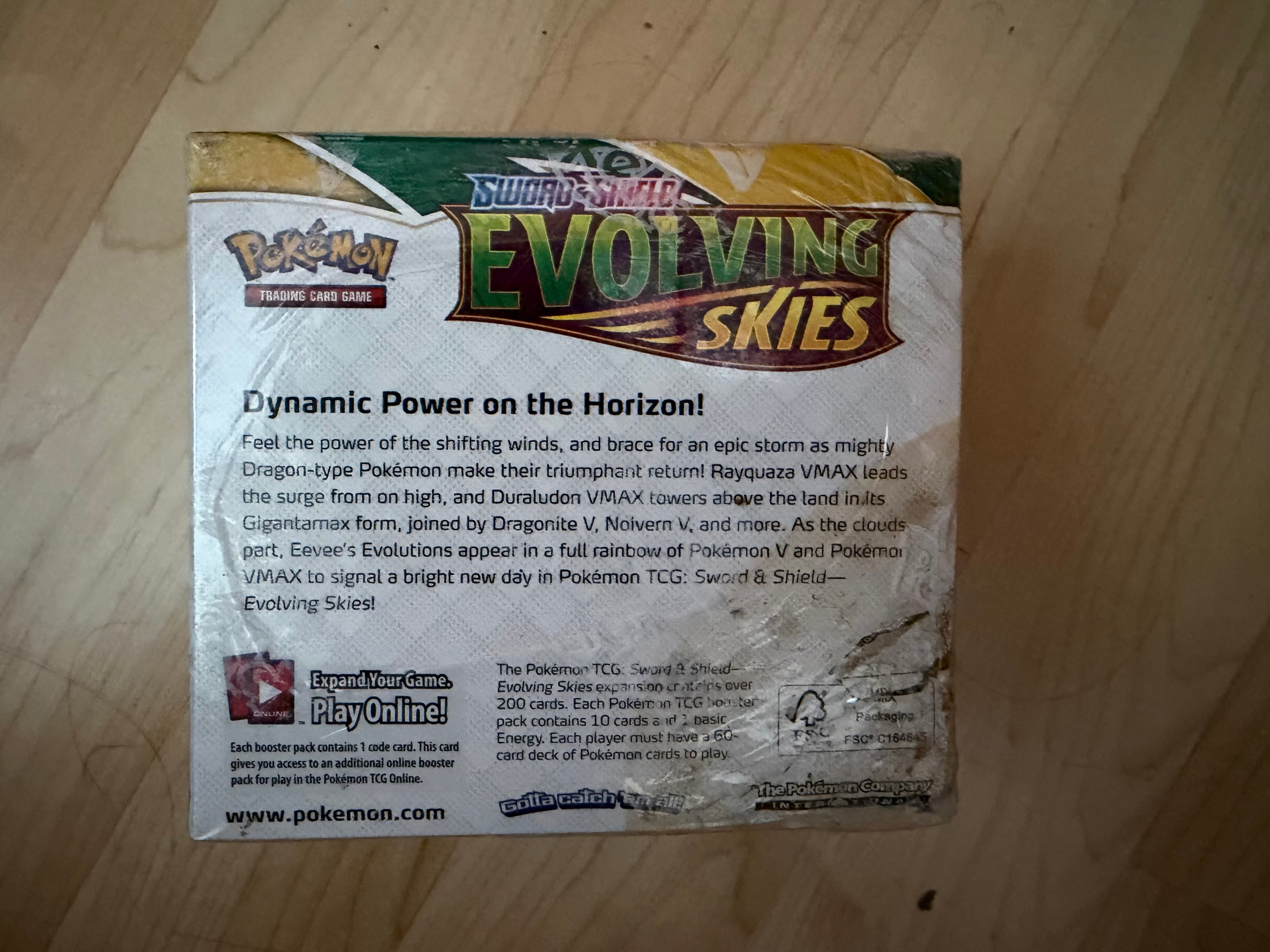
Damaged Pokemon Card Booster Box of Evolving Skies
Not setting a budget (especially with blind boxes & cards)
Collecting gets expensive fast across every category. A full wave of Marvel Legends is $175-280. A Pop Mart series of twelve boxes at $15-17 each is $180-204 before you factor in chasing the secret. S.H. Figuarts imports run $70-100 per figure. Pokemon booster boxes are $90-140.
Without a monthly budget, it all blurs together. You tell yourself "it's only $15" eight times and suddenly you've spent $120 on blind boxes in a week.
Set a number and stick to it. A lot of collectors I know land around $100-200 per month and adjust around big releases. The real test: if buying a collectible means skipping something you actually need, skip the collectible. Track spending in a spreadsheet so you see the real total.
Chasing completionism
This turns a fun hobby into a chore. You decide you need every figure in a Marvel Legends wave, every Labubu in a Pop Mart series, every card in a Pokemon set. Suddenly you're buying things you don't even like to fill gaps in a checklist.
A full wave of Marvel Legends is 6-8 figures at $25-35 each. A complete Pop Mart blind box series can take 20+ purchases because of duplicates and random distribution. A complete Pokemon master set can run into the hundreds of individual cards.
Collect what you actually enjoy. If you only want three figures from a wave, buy three. If you love four designs from a blind box series, buy four and trade duplicates. The Build-A-Figure piece? You can find loose BAF parts on eBay for $15-30. The secret Labubu? It'll show up on the secondary market.
Not tracking your collection
I didn't keep an inventory for my first two years. When I tried to get insurance quotes, I had nothing to show. When I wanted to sell pieces, I couldn't remember what I paid. When someone asked if I had duplicates, I genuinely didn't know.
A basic spreadsheet works. Item name, what you paid, estimated current value, condition. Take photos of everything, boxes included. Update values once or twice a year using completed eBay listings, Wheeljack's Lab for vintage figures, or Price Charting for cards.
I'll be honest, seeing my actual total spent for the first time was uncomfortable. Thousands on things I rarely looked at. It made me pickier, which is the point.
Overpaying on the aftermarket
Prices spike right after release when supply is thin and everyone's panicking. They almost always settle within a few months.
If you missed a preorder or a drop, wait. Check eBay sold listings (not active listings, sold) to see what people are actually paying. A figure listed at $150 and a figure selling at $150 are different things.
Same goes for selling. Don't price based on the hype peak from six months ago. Check current completed sales. Markets move.
Frequently Asked Questions
How do I spot a fake Labubu or Pop Mart blind box?
Buy from Pop Mart directly or authorized retailers. Counterfeits copy the outer box well, but the figure inside has rougher seams, slightly off colors, and cheaper vinyl that feels different in hand. If you're buying secondhand and the price is well below retail, be skeptical.
What's the best way to store Pokemon cards long-term?
Use penny sleeves inside hard top loaders for high-value cards, and acid-free polypropylene binder pages for the rest. Never use PVC pages, they off-gas chemicals that leave permanent residue on card surfaces. Store everything in a climate-controlled space at 35-45% humidity, away from direct light.
How much do collectors typically spend per month?
It varies widely, but most hobbyists I know set a budget between $100-200 per month. Blind box collectors tend to spend more impulsively because of the low per-unit price. Whatever your number is, the important thing is having one and tracking it.
Should I grade my Pokemon cards or action figures?
Only if the math works. For Pokemon cards, the general advice is to grade cards worth $75+ raw that you believe will hit a PSA 9 or 10. Most collectors overgrade their own cards by 1-2 points (PSA 10 as an actual 9) so get feedback from grading communities or knowledgeable friends before submitting. For action figures, AFA grading runs around $200 for standard service, so the figure needs to be worth significantly more graded to justify the cost.
Are blind boxes and trading cards a waste of money?
Not inherently, but they're designed to encourage overbuying. The random hit element means you'll get duplicates, and chasing a specific pull (especially chases with 1-in-144+ odds) can get very expensive quickly. Buy the versions you genuinely like, trade your duplicates, and set a hard stop for each set. At the end of the day, opening a blind box or card pack to see what you get is fun. Fun is what you're paying for, don't over do it. You don't want to be on the next Caleb Hammer Youtube episode.
Enjoyed this? Get collector insights delivered weekly.
Join the Bamboo Club for weekly collector tips, trends, and exclusive finds.
By subscribing you agree to receive Pando Market marketing emails. We will email you a link to confirm. Unsubscribe anytime. See our Privacy Policy.
Related Posts
Everything a new collector needs to know about picking a focus, setting a budget, spotting fakes, and displaying figures as a beginner.
Learn how to spot fake collectibles across action figures, Labubu blind boxes, Funko Pops, and trading cards. Protect your collection and your wallet.