
How to Value Your Toys: Free Tools and Price Guides
- Free tools that show you real prices
- Paid databases and specialty price guides
- Why condition changes everything
- The mistakes that cost collectors money
- When to get a professional appraisal
- Putting it all together
- Key Takeaways
- FAQs
- How do I check what my toys are worth for free?
- Why is my toy worth less than what I see it listed for on eBay?
- Does keeping the box really matter that much?
- How often do toy values change?
- Should I get my toys professionally appraised?
- Related Posts
What's my collection actually worth? Every collector asks this question eventually. Maybe you inherited a box of vintage Star Wars figures from a relative. Maybe you've been buying Marvel Legends for five years and want to know if your shelf has real dollar value. Or maybe you just pulled a chase variant and need to know whether to hold or sell. The answer is never a single number. It depends on what tools you use, how honestly you assess condition, and whether you're looking at what people ask for or what people actually pay.
I've made plenty of valuation mistakes over the years. The biggest one was trusting listing prices instead of sold prices, which led me to believe a figure was worth three times its actual market value. That's a lesson I want to save you from. Here's how to figure out what your toys are really worth using free tools, paid databases, and a realistic understanding of what drives prices up or down.
Free tools that show you real prices
The single best free tool for valuing toys is eBay's sold listings filter. Not active listings. Sold listings. The difference matters more than anything else in this guide.
Here's how to use it. Search for your item on eBay, then look for the "Show only" section in the left sidebar and check "Sold Items." On mobile, tap the Filters button and select "Sold Items" under Show Only. The results show what buyers actually paid, with prices displayed in green for items that sold and red for listings that ended without a sale. Sort by most recent to see current market prices, not what something sold for six months ago.
A few things to keep in mind. eBay only shows the last 90 days of completed sales, so rare items with infrequent sales might not have much data. Look for at least three comparable sales within the past 30 days to establish a reliable current value. Pay attention to condition descriptions and photos in those sold listings, not just the final price. A MISB (mint in sealed box) figure selling for $200 tells you nothing about what your loose, played-with version is worth.
For trading cards and video games, PriceCharting is the go-to free resource. Their algorithm pulls from eBay sold data and their own marketplace, then calculates current market prices using weighted averages that account for outliers and sale dates. They break prices down by condition too: ungraded, PSA 10, BGS 10 for cards, and loose, complete in box, new, and graded for games. You can also add items to a collection tracker and watch your total value change over time. I use it for every card purchase.
For a broader look at collectible values across categories, the eBay Collected Report publishes periodic data on trending collectibles and market shifts. It's not a price guide per item, but it's useful for understanding which categories are heating up or cooling down.
Paid databases and specialty price guides
Free tools cover most situations, but if you're dealing with vintage action figures from the 1960s through 1990s, Wheeljack's Lab is worth bookmarking. Their free price guide tracks over 195,000 actual sales across brands like Transformers, G.I. Joe, Star Wars, He-Man, and Teenage Mutant Ninja Turtles. Prices update daily, and the data goes back decades. It's the most comprehensive vintage toy price database I've found, and the fact that it's free is genuinely surprising. They've been running since 1999 and have served over 300,000 collectors.
For eBay data beyond the 90-day window, Terapeak (built into eBay Seller Hub) gives you up to three years of sales history. If you sell regularly, it's already included with your eBay account. WorthPoint is another option, claiming 15+ years of historical auction data from eBay and other marketplaces, though it requires a paid subscription.
Apps like iCollect Everything and Collectibles.com let you scan barcodes, track values, and manage your collection inventory from your phone. They're useful for cataloging what you own, though I'd always cross-reference their values against eBay sold data before making any buying or selling decisions.
Why condition changes everything
Condition is the single biggest factor in toy valuation. A rare figure in poor shape will almost always sell for less than a common figure in perfect condition. That's not an exaggeration. It's how the market consistently works.
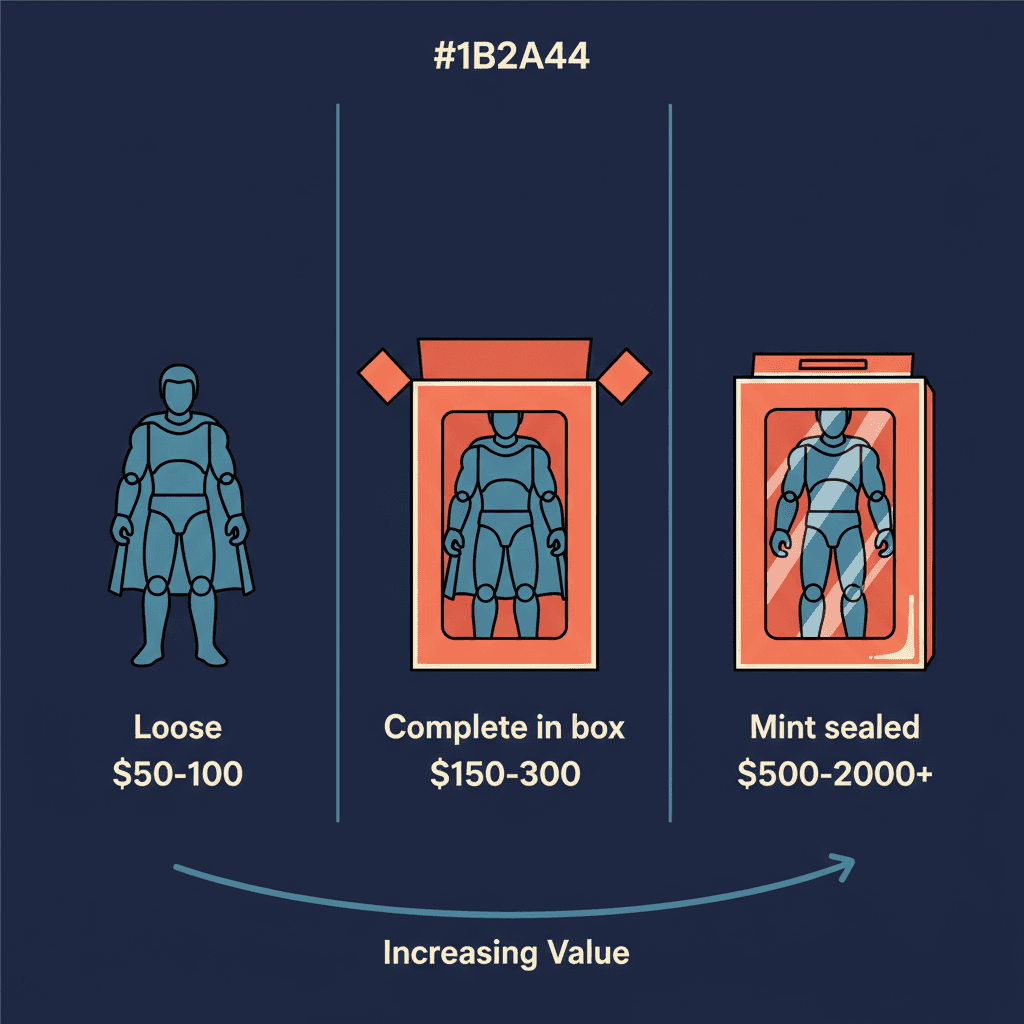
The numbers are dramatic. A vintage toy in its original sealed packaging (MISB) can sell for 5 to 20 times more than the same toy loose without packaging. A loose 1980s Optimus Prime in good condition might sell for $200. The same figure sealed in its box can hit $1,000 or more. A loose vintage Boba Fett might go for $300, while one on its original card could fetch over $2,000.
For action figures specifically, the collector community uses the C-scale, running from C1 (poor) to C10 (perfect). Most collectors and dealers only deal in C8 and above unless the figure is genuinely rare. Here's a rough breakdown of what the grades mean in practice:
- C10: Perfect. Factory-fresh with zero flaws. Extremely rare even for new figures.
- C9: Near mint. Barely noticeable imperfections. This is the sweet spot for serious collectors.
- C8: High quality collectible. Minor wear, slight card creasing, maybe a small yellowed bubble. Still very displayable and desirable.
- C7 and below: Visible wear, paint chips, loose joints. Value drops significantly. Most dealers won't stock these unless the figure is hard to find.
If you have figures in that C9-C10 range and they're from a valuable line, professional grading can amplify the premium even further. The math works for vintage pieces already worth $200 or more.
The packaging matters just as much as the figure itself. A mint figure on a crushed card loses significant value compared to the same figure on a clean card. Even having the original box with some shelf wear adds real value compared to having no box at all.
The mistakes that cost collectors money
The most expensive valuation mistake is using listing prices instead of sold prices. I see this constantly on Reddit and collector forums. Someone searches eBay, finds their figure listed for $500, and assumes that's what it's worth. But a listing price is just what a seller typed into a box. It's proof of nothing except optimism. The sold price is the only number that matters, and the gap between the two can be enormous.
Other common mistakes:
Ignoring condition differences. Your played-with figure is not worth what a sealed one sold for. Compare apples to apples. A $400 sale for a MISB figure doesn't mean your loose version with paint wear is worth $350. It might be worth $60.
Checking one data point. A single sale doesn't establish value. One auction might have had two aggressive bidders driving the price up, or a listing might have sold low because of bad photos and a vague title. Look at multiple recent sales and find the range.
Forgetting about fees. If you're selling, eBay takes roughly 13% plus PayPal or payment processing fees. A figure that sells for $100 nets you around $85 before shipping costs. Factor that into your valuation if you're thinking about selling.
Overvaluing nostalgia. Your childhood toys mean a lot to you. That emotional value doesn't translate to market value. A He-Man figure that defined your childhood might be worth $8 loose. That's okay. Sentimental value and dollar value are different things.
Not accounting for market trends. Toy values fluctuate with media releases, nostalgia cycles, and collector demographics. Values aren't permanent. A figure that's hot today might cool off in two years when the next movie wave hits.
When to get a professional appraisal
For most collections, the free tools I mentioned above are more than enough. But there are a few situations where paying for a professional appraisal makes sense.
Insurance documentation. If your collection is worth more than a few thousand dollars, you should have it documented for insurance purposes. Standard homeowner's policies typically cap collectible coverage at low amounts, and you'll need a detailed inventory with values to get proper coverage. Companies like Collectibles Insurance Services and American Collectors Insurance offer specialized policies with $0 deductibles and coverage for accidental breakage, theft, fire, and flooding. They don't require formal appraisals for individual items under $25,000, but you'll need descriptions and estimated values for everything.
Selling a large inherited collection. If you've inherited hundreds of vintage toys and don't know the hobby well, a professional appraisal prevents you from accidentally selling a $2,000 figure for $20 at a garage sale. Services like ValueMyStuff offer online appraisals within 24 hours. Mearto provides similar turnarounds at 48 hours. For free options, the Buddy L Toy Museum has offered free vintage toy appraisals for over 50 years.
Estate planning. Documenting your collection's value for estate purposes requires more formal documentation than screenshots of eBay sold listings. A credentialed appraiser from the Appraisers Association of America, the American Society of Appraisers, or the International Society of Appraisers can provide documentation that holds up legally.
For everyday "what's this worth" questions, save your money and use eBay sold listings. Professional appraisals make sense when real money or legal documentation is on the line.
Putting it all together
Here's the process I use every time I need to value a toy or figure:
- Search eBay sold listings for the exact item in comparable condition. Look at 3-5 recent sales.
- Cross-reference with a specialty database. Wheeljack's Lab for vintage, PriceCharting for cards and games.
- Be honest about condition. Grade your item using the C-scale and compare it to sold listings in the same condition range.
- Check the trend. Is the price going up, down, or holding steady? A few months of data tells you more than a single sale.
- Subtract fees if you're planning to sell. That final number is your realistic take-home value.
If you're new to collecting, building the habit of checking sold prices before you buy anything on the aftermarket will save you hundreds of dollars over time. And if you ever spot a deal that seems too good to be true, verify the item is authentic first. A cheap price on a fake figure isn't a deal. It's a loss.
Frequently Asked Questions
How do I check what my toys are worth for free?
Start with eBay sold listings. Search for your item, filter by "Sold Items" under Show Only, and look at what buyers actually paid in the last 90 days. For trading cards and games, PriceCharting tracks prices across conditions with free access. For vintage action figures from the 1960s through 1990s, Wheeljack's Lab offers a free database of over 195,000 recorded sales with daily price updates.
Why is my toy worth less than what I see it listed for on eBay?
Because listing prices reflect what sellers hope to get, not what buyers actually pay. The gap can be significant. A figure listed at $500 might consistently sell for $120. Always filter for sold listings to see real transaction prices. If you're making buying or selling decisions based on active listing prices, you're working with unreliable data.
Does keeping the box really matter that much?
Yes. For vintage toys especially, the original packaging can represent 50-80% of the total value. A sealed figure (MISB) routinely sells for 5-20 times more than the same figure loose. I break down exactly how much value a figure loses when you open it in the MOC vs. loose guide, with specific numbers by toy line. Even a damaged box adds meaningful value compared to no box at all. For modern figures, the premium is smaller but still real, particularly for limited editions and exclusives.
How often do toy values change?
Constantly. Values shift with new movie announcements, nostalgia cycles, production changes, and collector demographics. A figure tied to a character getting a new show or movie can spike in value temporarily. The opposite happens too. Checking eBay sold data quarterly for your most valuable pieces is a reasonable habit. PriceCharting and Wheeljack's Lab update daily if you want more frequent tracking.
Should I get my toys professionally appraised?
For most collectors, free tools like eBay sold listings and Wheeljack's Lab give you accurate enough values. Professional appraisals become worthwhile when you need insurance documentation for a collection worth several thousand dollars, when you've inherited a large collection you're unfamiliar with, or when estate planning requires legally defensible valuations. Services like ValueMyStuff and Mearto offer online appraisals for around $10-30 per item.
Enjoyed this? Get collector insights delivered weekly.
Join the Bamboo Club for weekly collector tips, trends, and exclusive finds.
Related Posts
Learn how to spot fake collectibles across action figures, Labubu blind boxes, Funko Pops, and trading cards. Protect your collection and your wallet.
Avoid the most common toy collecting mistakes. Learn how to spot fakes, store collectibles properly, set a budget, and stop overpaying on the aftermarket.