
How to sell your toy collection without losing money
- Know what you have before you list anything
- Where to sell: platform comparison
- Photography and listing tips that actually matter
- Lots vs. singles: the strategy that saves your sanity
- Timing your sales
- The part nobody talks about: letting go
- A quick note on taxes
- Key Takeaways
- FAQs
- What's the best platform to sell collectible toys in 2026?
- How do I find out what my toys are worth?
- Should I sell my collection all at once or piece by piece?
- Do I have to pay taxes on selling my toy collection?
- How do I avoid selling a fake collectible by mistake?
- Related Posts
You've been thinking about it for a while. Maybe the shelves are full. Maybe you need the money. Maybe you just don't feel the same way about certain figures or boxes that you used to. Whatever the reason, you've decided to sell part (or all) of your collection, and now you're staring at a closet full of plastic wondering where to even start.
I've sold pieces of my collection three separate times. The first time, I way underpriced everything because I just wanted it gone. The second time, I listed 40 individual items on eBay and burned out by listing number 12. The third time, I finally figured out a system that worked. Here's what I learned.
Know what you have before you list anything
The single biggest mistake sellers make is skipping research. You think that vintage Kenner figure is worth $200 because someone on Facebook said so. You check eBay and see one listed at $180. But listed price means nothing. Sold price is what matters.
Go to eBay, search for your item, and filter by "Sold Items" under the "Show Only" section. This shows you what people actually paid in the last 90 days, not what some optimistic seller is hoping to get. Look at the last 10 sold listings for your specific item in comparable condition and take the median. That's your realistic number.
For vintage figures specifically, Wheeljack's Lab has over 192,000 recorded sales. Price Charting covers trading cards well. I wrote a full guide to valuing your toys with every free and paid tool worth using. These are real data, not guesswork.
A few things that affect value more than people expect: whether the item is sealed (MOC/MIB/MISB figures sell for significantly more than loose), the specific variant or wave, and the actual condition of the box or card back. Collectors are meticulous. A crease on a card back or a dented box window drops value fast.
If you've been tracking your collection in a spreadsheet, this step is much easier. If you haven't, now's the time to start one. List every item, what you paid, and the current sold comp value. That spreadsheet becomes your selling roadmap.
Where to sell: platform comparison
Not every platform suits every situation. Here's how the main options break down in 2026.
eBay remains the largest marketplace for collectibles, with over 182 million active buyers. Final value fees run about 13.25% on most collectible categories (that includes the payment processing), plus $0.30-$0.40 per order. You get 250 free listings per month. The advantage is reach. The disadvantage is that fees eat roughly 13-15% of every sale, and you're responsible for shipping, handling disputes, and dealing with the occasional problem buyer. For high-value individual items, eBay is still the best option because the buyer pool is enormous.
Mercari charges a flat 10% selling fee. The interface is simpler than eBay, listing is faster, and it's popular with younger collectors. The buyer pool is smaller, so niche or vintage items may sit longer. Good for figures in the $15-75 range where eBay's per-order fee would eat more of your margin.
Facebook Marketplace has no fees on local pickup sales, which makes it the best option for bulky lots or lower-value items where shipping costs would kill your profit. You meet the buyer, hand them the box, collect cash or Venmo. The downside is that you're limited to local buyers (unless you ship, at which point the fee is around 10%), and flaky buyers are common. I'd estimate one in three arranged meetups falls through in my experience.
[Whatnot](https://www.whatnot.com) is the live auction platform that's taken over the collectibles space. Fees are about 8% plus payment processing (2.9% + $0.30). The format works well if you have volume, because you can move 20-30 items in a single stream. You need seller approval first, which takes 5-14 days. Sellers who figure out the format report moving more product in one stream than weeks of passive listings. The catch is you need to be comfortable on camera and able to build an audience.
Consignment and auction houses like Hake's and Heritage Auctions are for high-value items and large collections. Hake's charges commissions as low as 10% with no extra fees, and they handle photography, catalog copy, and marketing to their registered collector base. Heritage is the largest collectibles auctioneer in the world and offers cash advances on consignments. These are not for your $30 loose figures. They're for when you have a sealed vintage Star Wars collection or a grail-tier lot worth thousands.
Direct buyers like Brian's Toys, Wheeljack's Lab, and Sell Your Toys Now will buy your collection outright. Fast and easy, but you'll get 40-60% of market value because they need their margin. If speed matters more than maximizing every dollar, this is the lowest-effort path.
Photography and listing tips that actually matter
I've bought enough collectibles online to know that bad photos kill sales. You don't need a studio setup. You need a clean background, decent lighting, and multiple angles.
Use a white poster board or a plain table against a wall. Natural light from a window works. Take at least four photos: front, back, close-up of any damage or notable details, and one showing the item in context (next to a ruler for scale, or showing the full box). For sealed items, photograph the seal itself so buyers can verify it hasn't been opened and resealed.
Titles matter more than descriptions on most platforms. Include the brand, character name, line name, condition, and whether it's sealed or loose. "Marvel Legends X-Men '97 Wolverine 6-inch Figure MOC" tells a buyer everything in one line. "Cool Wolverine figure for sale" tells them nothing.
In the description, be honest about condition. Note every scuff, crease, tear, loose joint, or missing accessory. Buyers who collect are examining your photos with a magnifying glass mentality. If you hide a flaw and they find it on arrival, you're getting a return request and a negative review.
Before listing anything valuable, make sure you can verify its authenticity. If you accidentally sell a bootleg, the platform will side with the buyer, and you'll lose both the item and the money.
Lots vs. singles: the strategy that saves your sanity
Listing every item individually will get you the most money. It will also consume your life. I tried listing 40 items one by one and I wanted to quit after the twelfth.
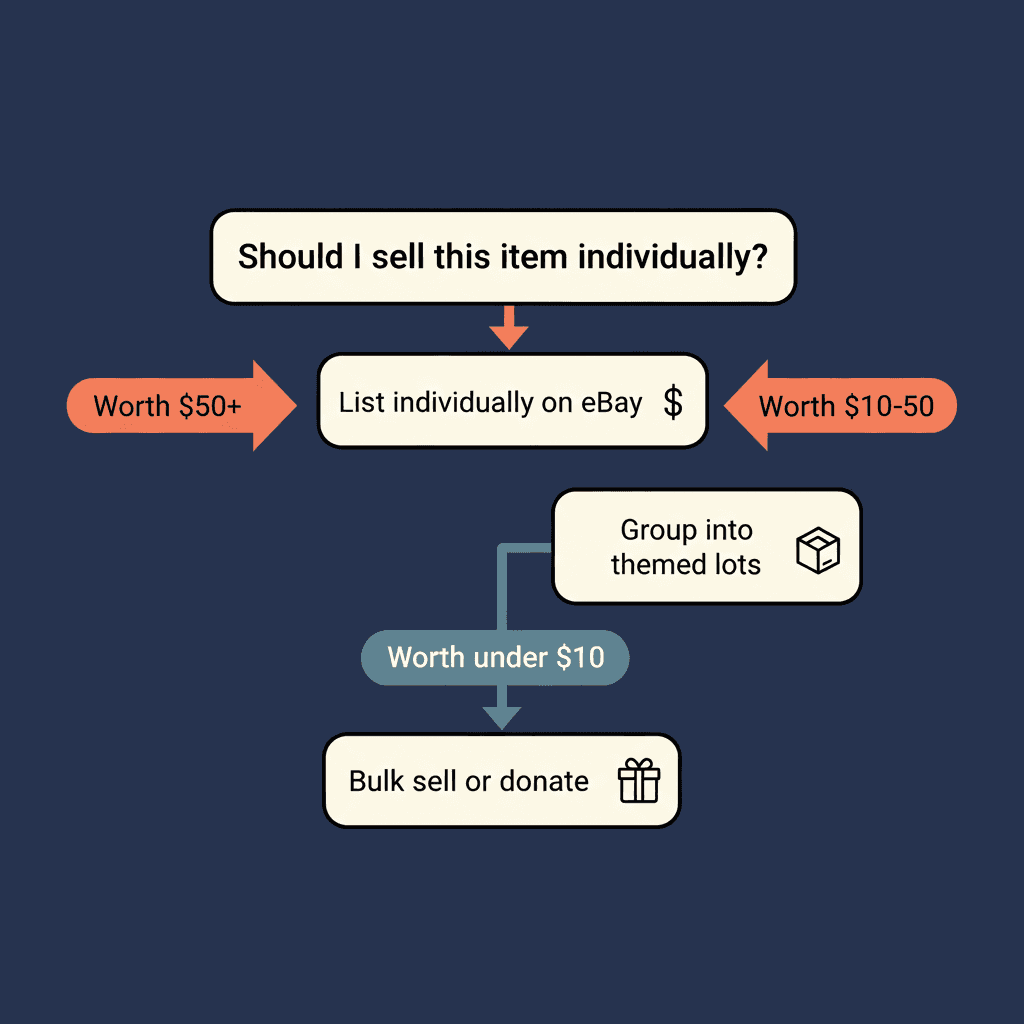
Here's the approach that actually works: sort your collection into three tiers.
Tier 1 (sell individually): Items worth $50+ that have strong demand. These are worth the time to photograph well, write detailed descriptions, and list on eBay with a Buy It Now price based on sold comps. This is where you'll make the most of your money.
Tier 2 (sell in themed lots): Items worth $10-50 each. Group them by franchise, era, or line. A lot of 8 loose Marvel Legends X-Men figures will attract a buyer faster than 8 separate listings, and you save on shipping. Price the lot at 70-80% of what the items would fetch individually. The convenience premium is worth it.
Tier 3 (bulk sell or donate): Items worth under $10 individually. Random loose figures with missing accessories, common Funko Pops, opened blind boxes. Bundle these into big lots, sell them on Facebook Marketplace for local pickup, or donate them. The time cost of listing a $6 item individually on eBay (photos, description, packaging, shipping) means you're effectively working for less than minimum wage.
The hybrid approach maximizes your return while keeping you from burning out before you're halfway through.
Timing your sales
When you list matters more than you'd think. The collectibles market has a clear seasonal pattern.
October through December is peak season. Holiday gift buying drives demand up across every category. Around 70% of annual toy and game revenue comes in Q4. If you can wait to list your bigger items during this window, you'll see higher final prices and faster sales.
January and February are typically slower. Buyers just spent through the holidays. Prices on the secondary market dip. This is a bad time to sell unless you need to.
Convention season (spring and summer) creates spikes around specific franchises. SDCC exclusives and product reveals generate renewed interest in certain toy lines. If you're selling Star Wars or Marvel figures, listing right after a major product announcement or convention can ride that wave of attention.
The worst time to sell? Right after a manufacturer announces a reissue. Those X-Men '97 figures I overpaid for on the aftermarket dropped in value the moment Hasbro announced the restock.
The part nobody talks about: letting go
I want to be honest about something. Selling a collection is emotional. These aren't just products. They're tied to memories, phases of your life, and sometimes people who gave them to you.
The first time I sold a figure I'd had for years, I felt a pang of regret the second I packaged it up. That feeling faded within a week. The shelf space I freed up felt better than the figure that was sitting there collecting dust.
A few things that help. Keep one or two pieces that represent what the collection meant to you. A single figure can carry the memory of an entire era of collecting. Take photos of everything before it goes. The memories live with you, not in the boxes.
And if you're selling because you need money, there's no shame in that. Collections are assets. Using them when you need to is responsible, not giving up.
A quick note on taxes
This trips people up every year, so here's the short version. If you sell collectibles at a profit (meaning you sell for more than you originally paid), the gains are potentially taxable.
For items held over a year, the IRS taxes collectible gains at a maximum rate of 28%, which is higher than the standard long-term capital gains rate on stocks. For items held under a year, gains are taxed as ordinary income at your regular tax bracket.
The good news for most hobby sellers: the 1099-K reporting threshold is back to $20,000 and 200+ transactions for 2025 and beyond, after the planned $600 threshold was reversed. But some states still use the $600 threshold, so check your state's rules.
If you're selling a collection at a loss (which is common when selling opened or played-with items), you generally can't deduct hobby losses against other income. Keep records of what you paid and what you sold for. A spreadsheet tracking purchase price, sale price, fees, and shipping costs for every transaction makes tax time much simpler.
I'm not a tax professional and this isn't tax advice. If you're selling a large collection, talk to a CPA who understands collectibles.
Frequently Asked Questions
What's the best platform to sell collectible toys in 2026?
It depends on what you're selling. eBay is best for individual high-value items because of the massive buyer pool. Facebook Marketplace works well for local sales and bulk lots where you'd rather avoid shipping fees. Whatnot is strong if you have volume and you're comfortable with live selling. For truly valuable or vintage collections, consignment through Hake's or Heritage Auctions reaches serious collectors willing to pay premium prices.
How do I find out what my toys are worth?
Use eBay's Sold Items filter, not active listings. Active listings show what people hope to get, not what buyers actually pay. Search for your specific item, filter to Sold, and look at the last 10 transactions. For vintage action figures, Wheeljack's Lab has over 192,000 sales records. For trading cards, Price Charting tracks market values across sets.
Should I sell my collection all at once or piece by piece?
A hybrid approach works best. Sell high-value items ($50+) individually to maximize return. Group mid-range items ($10-50) into themed lots by franchise or toy line. Bulk sell or donate items under $10. Trying to list everything individually will burn you out, and selling everything as one giant lot leaves money on the table.
Do I have to pay taxes on selling my toy collection?
Potentially, yes. If you sell items for more than you paid, the profit is taxable. The IRS taxes long-term collectible gains at up to 28%. The 1099-K reporting threshold is $20,000/200 transactions at the federal level, but some states use a $600 threshold. Keep records of purchase prices, sale prices, and all fees. Talk to a tax professional if you're selling a large collection.
How do I avoid selling a fake collectible by mistake?
Before listing valuable items, verify authenticity. Check for common signs of bootlegs: softer plastic, messy paint applications, off-color packaging, and chemical smells. For trading cards, examine the card stock and edge quality. If you're unsure, compare your item against reference photos from the manufacturer or authentication guides. Accidentally selling a counterfeit leads to returns, refunds, and potential account suspension on most platforms.
Enjoyed this? Get collector insights delivered weekly.
Join the Bamboo Club for weekly collector tips, trends, and exclusive finds.
Related Posts
Learn how to spot fake collectibles across action figures, Labubu blind boxes, Funko Pops, and trading cards. Protect your collection and your wallet.
Avoid the most common toy collecting mistakes. Learn how to spot fakes, store collectibles properly, set a budget, and stop overpaying on the aftermarket.